

Some kids run on a different battery.
If you are reading this because your kid has been climbing the back of the couch, jumping off the second-to-last stair, or doing somersaults at the dinner table while the rest of the family eats — this post is for you.
The high-energy kid is not a problem to solve. They are a kid whose body needs a job. Give them the job and the chaos drops by maybe 60% in a week. Try to suppress the energy and you will lose every time.
Here is the protocol we tell parents of high-energy 3- to 8-year-olds.

What "high energy" actually means
Three signals usually point at the same kid:
- Cannot stay seated through a meal
- Wakes up at 100% and ramps from there
- Crashes hard if movement does not happen by mid-afternoon
This is not ADHD. This is not a behavior problem. This is a normally-developing kid whose nervous system runs hotter than average and who needs more daily movement volume than the standard recommendation.
The WHO 60-minute-a-day guideline is the floor. For high-energy kids it is closer to 120 to 180 minutes of total movement per day — and it has to be distributed, not stacked into one session.
The three-block schedule that works
The single best thing you can do for a high-energy kid is split their movement into three short blocks spread across the day, instead of one long block. Three 8-minute sessions beat one 24-minute session for behavior every time.
The schedule that works in our own house and in the homes of beta families using BabyGains Play:
- Morning, 6:45–7:00 AM — Wake Up routine, 5 to 8 minutes. Bodyweight only.
- After school or after lunch, 3:30 PM — Energy Burn routine, 8 to 10 minutes. With gear if you have it.
- 45 minutes before dinner, ~5:00 PM — Wind-down routine, 5 minutes. Lower intensity, longer holds.
Block one resets the day. Block two prevents the late-afternoon crash. Block three transitions them into evening mode without a full meltdown.
If you can only do one block, do block two. The 3:00 to 5:00 PM window is when high-energy kids cause the most household chaos, and the post-school movement session is the single biggest intervention you can run.
Which routines in the app to use
Inside the app, there is a tag called Energy Burn that filters for higher-intensity routines. These are the ones designed for the high-energy kid.
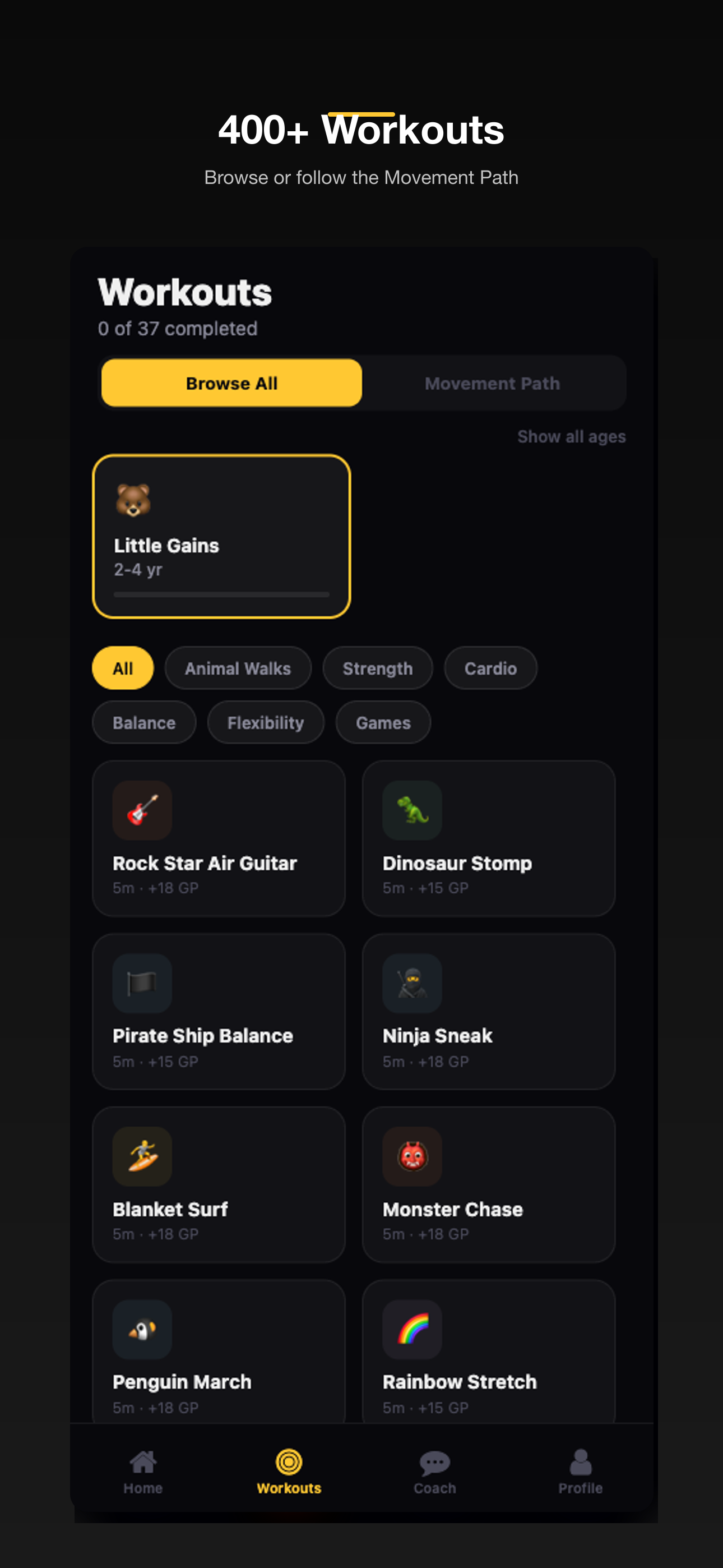
The ones to look for, by age band:
- Strong Start (2-4): "Jumping Animals," "Rocket Squats," "Floor Is Lava"
- Power Up (4-6): "Tabata Hop," "Crawl Olympics," "Mini Metcon"
- Big Movers (6-8): "AMRAP-3," "Sprint Sets," "Carry & Climb"
All of these are between 5 and 10 minutes. None of them require equipment. All of them are designed to spike heart rate, channel intensity, and leave a kid pleasantly tired — not exhausted.
For kids who like to lift, add the Kids Power Pack or the Kids Elite Barbell Kit. Loaded movement at this intensity level burns even more of the wiggles, and high-energy kids tend to gravitate toward the heaviest object in the room anyway.
The "give them a job" principle
There is a deeper psychology at play here. High-energy kids do not just need movement. They need *tasked* movement. A kid who is told "go run around the backyard" lasts about three minutes before they wander back inside looking for trouble. A kid who is given "go do 20 bear crawls to the fence and back" is locked in for eight minutes.
The app provides the task. The timer is the structure. The badge is the reward. That entire loop is engineered for the high-energy kid — they need the assignment, the clock, and the validation more than the average kid does.
Without the structure, the energy goes into furniture-destruction. With the structure, the energy goes into the routine and your kid is calmer for an hour afterward.
The mistakes to avoid
Three things parents do that backfire with high-energy kids:
- Try to "tire them out" with one massive session. Doesn't work. They have more stamina than you. You will tap out before they do. Distribute the load.
- Skip movement on rainy days. This is the worst day to skip. A high-energy kid stuck inside without a session becomes a wrecking ball within 90 minutes. Run a 5-minute indoor routine instead.
- Treat the energy as misbehavior. It is not. It is biology. Punishing a kid for their nervous system never works. Channeling it does.
What changes in a week
The pattern most parents report inside the first 7 days:
- Day 1-2: kid does the routines, energy still high
- Day 3-4: kid starts asking when the next session is
- Day 5-7: meltdowns drop by roughly half, sleep improves, the "between sessions" calm starts showing up
By week 2, the routines are no longer about burning energy. They are about regulating it. The kid is still high-energy — that is who they are — but the energy is going somewhere instead of bouncing off everything.

The bigger picture
You are not trying to make a high-energy kid into a calm kid. You are giving them tools to manage their own intensity, every day, for the rest of their life. That is the win.
The full walkthrough of how to set up sessions is in How to Use BabyGains Play in 5 Minutes. The science on why structured movement helps regulate kid behavior is in The Science of Raising Kids Who Move.
If you have a high-energy kid and you have been bracing for the meltdown every afternoon — open the app, filter for Energy Burn, and run the first routine you see. The protocol either works fast or it doesn't work at all. Most parents see the difference inside three days.