

My 5-year-old used to take 90 minutes to fall asleep.
We had the routine right. Lights low, white noise, story, lullaby, the works. None of it touched the actual problem — at 7 PM he was still vibrating at the same frequency he had been at 5 PM. The bedroom was calm. He was not.
The fix turned out to be a structured wind-down, starting one hour before bedtime, that used movement as the *first* step instead of the last. Counterintuitive. Highly effective. We have been running it for fourteen months and bedtime is no longer the worst hour of the day.
Here is the protocol.

Why movement helps sleep when you time it right
This is the part that gets the science wrong online. You will read "do not exercise before bed" everywhere. That advice is for adults, and even for adults it is partially wrong.
For kids, especially high-energy kids, the actual research shows the opposite. The AAP and CDC guidance on kids and sleep consistently identifies daytime physical activity as one of the strongest predictors of sleep latency (how fast a kid falls asleep) and sleep quality.
The trick is the *type* of movement in the hour before bed. Sprint work, jumping, high-intensity sessions — those will fire up the nervous system. Slow controlled movement, holds, stretching, breath-paced sequences — those down-regulate the nervous system. The body interprets the second category as a wind-down signal.
The 1-hour wind-down protocol uses this. You move first, but you move slow. The kid is physically settled by the time they hit the bed.
The 60-minute timeline
Counting backward from lights-out:
- T-60 minutes: Bath. Warm water signals the body to drop core temperature in the next 45 minutes, which is the physiological cue for sleep.
- T-50 minutes: Out of the bath. Pajamas on. Water bottle filled.
- T-45 minutes: 5-minute Wind-Down routine in the BabyGains Play app. (Specific routine below.)
- T-40 minutes: Tooth brushing, last toilet trip. Lights start dimming in the bedroom.
- T-30 minutes: Story. One book, not three. Lie down beside them.
- T-15 minutes: Lights off. Two-minute breathing exercise — slow in through the nose for 4 counts, out through the mouth for 6 counts.
- T-5 minutes: Silent presence. Stay in the room until breathing slows. Most nights you leave before they are asleep — they finish the drop on their own.
Total time: 60 minutes from bath to lights out. Lights out should hit at the same clock time every night (within a 15-minute window). Drift the schedule and the whole protocol weakens.
The 5-minute Wind-Down routine
This is the key block — five minutes of slow movement that signals "the day is ending." The app's "Wind-Down" routine in any age band runs this structure, but you can also run it manually:
- 45 seconds of cat-cow stretches. On hands and knees, arch back and look up, then round back and tuck chin. Slow, paced with breath.
- 45 seconds of standing forward fold. Reach for toes. Don't worry about touching them. Hold for 5 seconds, stand up halfway, fold again.
- 45 seconds of butterfly stretch. Sit on floor, soles of feet together, knees out. Bounce gently. Kids love this one.
- 45 seconds of child's pose. Knees wide, big toes touching, forehead to the floor, arms stretched forward. The single most effective wind-down position for a kid.
- 60 seconds of slow breathing on their back. Knees up, feet flat. Hand on belly. Watch belly rise and fall. You count the breaths out loud. Slow.
That is the routine. Calm voice throughout. No counting reps loudly, no high-energy cues. The whole thing should feel half-asleep already.
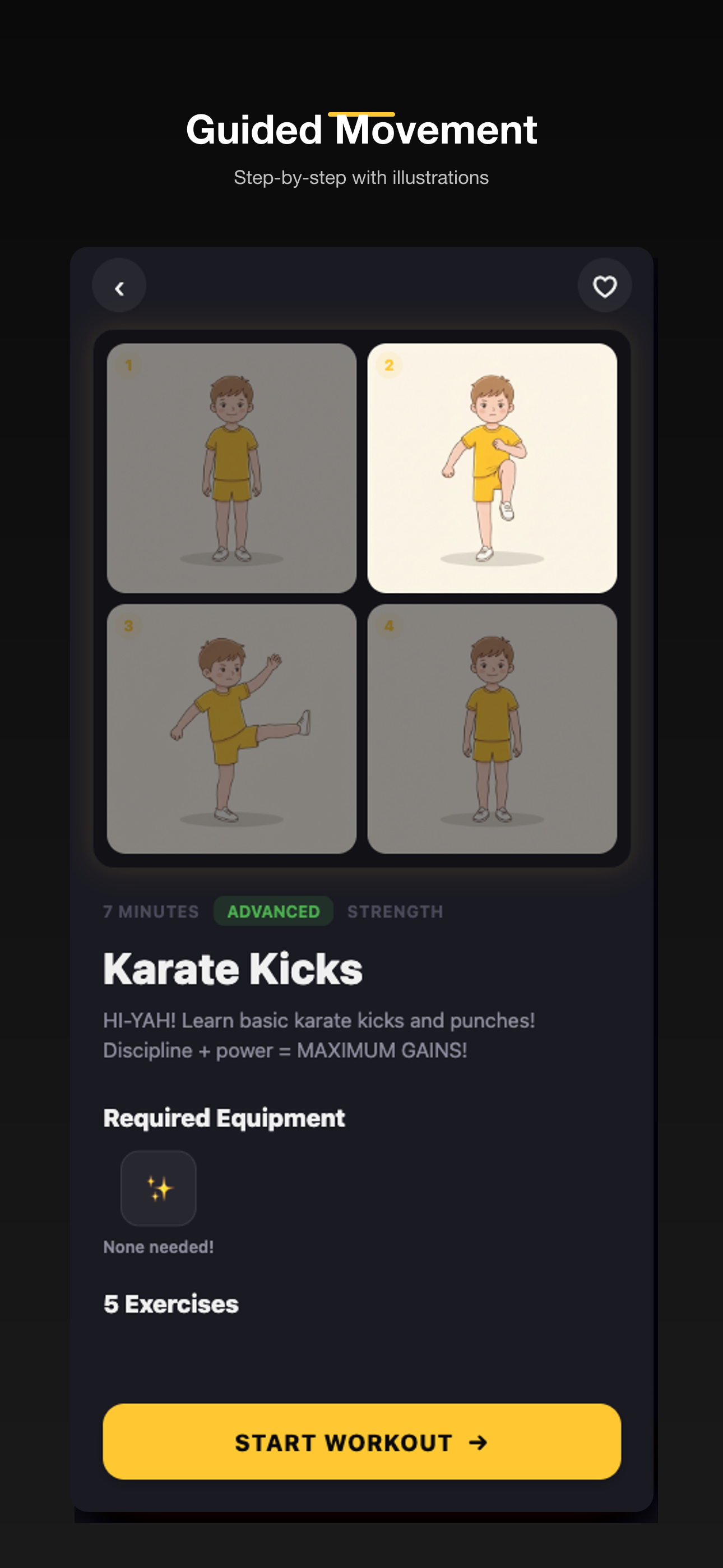
The app's version of this is in the Wind-Down category inside the workout tab. Same exact structure, with the calm parent voice doing the cueing so you can lie next to your kid instead of running the timer.
What to avoid in the hour before bed
The wind-down only works if the surrounding hour is also calm. The killers:
- Screens. No tablets, no shows, no phones in the hour before bed. The blue light is real, but the bigger problem is that screens are stimulating regardless of content. The wind-down protocol assumes zero screens after T-60.
- Sugar. No dessert in the wind-down hour. Save it for after dinner or earlier. The blood sugar spike triggers a brief alertness window that perfectly coincides with bedtime.
- High-intensity play. No wrestling, no chase games, no tickle fights. These flip the nervous system in the opposite direction. Save the chaos for the afternoon.
- Hard conversations. Do not bring up tomorrow's stress, do not discuss the bad behavior earlier in the day, do not negotiate consequences. The wind-down is a no-conflict zone. Disputes go to morning.
- Light. The bedroom should be dim by T-30 and dark at lights-out. If you need light to read the story, use a single warm-toned lamp, not the overhead.
The two-week test
If your kid currently takes more than 20 minutes to fall asleep, give this protocol fourteen consecutive nights before evaluating. It almost always takes about a week for the routine to install and another week for the falling-asleep time to drop.
The data parents usually report after two weeks:
- Sleep latency drops from 30+ minutes to 5-15 minutes
- Night wakings drop noticeably (movement during the day is the strongest predictor)
- Morning wake-up is calmer and earlier (kids on better sleep schedules wake up rested, not crashed)
If you have run the full protocol for two weeks and you see no change, the issue is probably not the wind-down — it is either a daytime movement gap (try the Energy Burn protocol) or something medical worth raising with your pediatrician.
How the app fits
The app's Wind-Down category is the single most under-used part of the routine library. Parents discover the Energy Burn routines first, run them in the afternoon, and never touch the wind-down side.
The wind-down routines are the other half of the deal. Five minutes, no equipment, calm voice, designed for the hour before bed. Once you have run a few, you will start adding them to the nightly rhythm automatically.
The bigger picture
Sleep is not separate from movement. They are the same system, running on a 24-hour loop. A kid who moves well during the day sleeps well at night. A kid who has structured wind-down at night moves well the next day. The 1-hour wind-down is the bridge between the two.
For the daytime side, the 5-Minute Kid Workout is the daily anchor. For high-energy kids, the three-block protocol handles the afternoon. The wind-down handles the night.
Three blocks, one wind-down, real sleep. That is the whole rhythm.
Open the app and add the Wind-Down routine to your bedtime tonight. Most parents see the first improvement within four nights.